



A strong retail sales report can make the American consumer’s wallet look more powerful than many shoppers feel.
The monthly retail sales report from the U.S. Census Bureau is a crucial broad read on consumer spending across stores, restaurants, gas stations, online retailers, auto dealers, and other businesses.
The report is important because consumer spending accounts for a large share of the U.S. economy, and investors, policymakers, and retailers closely monitor it.
But the report is not adjusted for price changes. That means things like higher gasoline prices, higher restaurant bills, or higher retail prices can lift the headline number even if shoppers are not buying much more.
This distinction matters.
Not all retail sales are improving
Retail sales rose 0.9% in May from April and 6.9% from a year earlier, according to the Census Bureau. Economists polled by Reuters had expected a 0.5% monthly gain.
The strength, however, was not evenly spread across the retail economy.
- Gas station sales surged 26.5% from a year earlier and rose 3.4% from April, reflecting higher fuel prices.
- Nonstore retailers (including online shopping) rose 12.2% from a year earlier and 1.5% from April.
- Sporting goods stores rose 11.3% from a year earlier
- Electronics and appliance stores rose 6.9%.
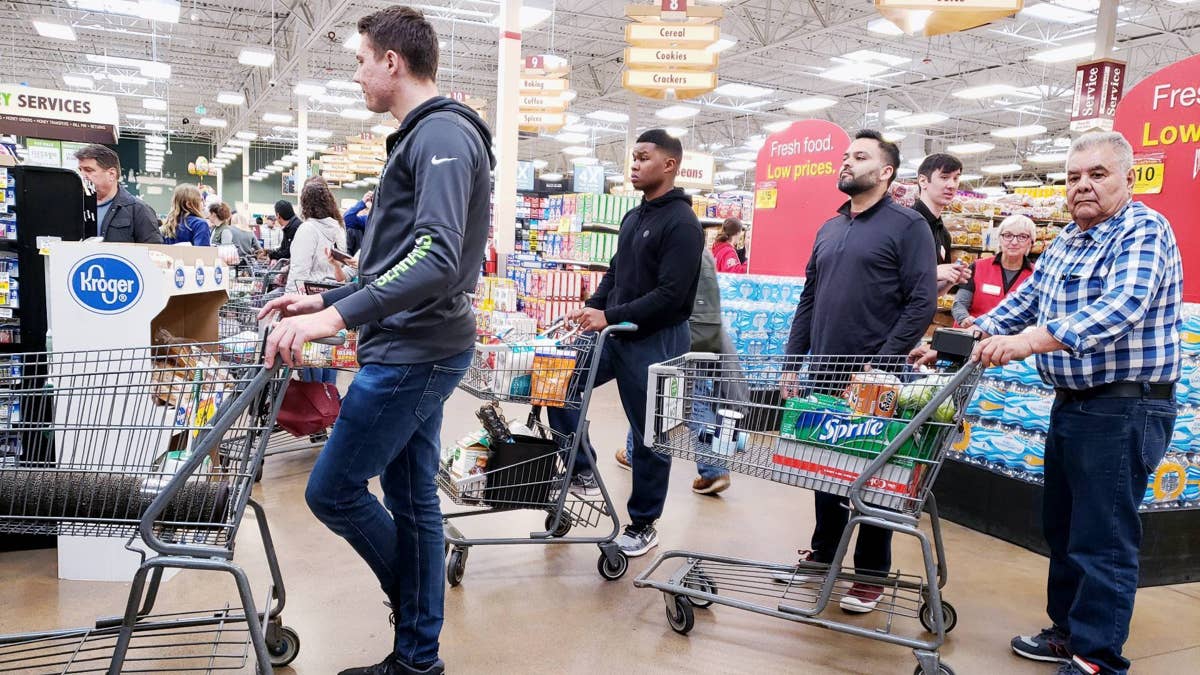
However, by comparison, grocery stores looked much weaker:
- Grocery store sales rose just 2.3% from a year earlier and were flat from April.
- Food and beverage stores overall were also flat from April and up 2.0% from a year earlier.
Related: Discontinued Pepsi soda brand quietly returns to stores
This gap was supported by Kroger, one of the largest US supermarket chains, which reported its first quarter 2026 earnings a day after the May retail reports.
The company’s earnings show that the broader retail sales boom is not translating into the same kind of momentum in the grocery aisle.
Kroger earnings show grocery growth is slowing
Kroger reported Q1 2026 earnings on June 18, with sales of $46.1 billion, up from $45.1 billion a year earlier.
That headline increase was positive, but the underlying grocery growth was more modest.
Identical sales without fuel rose 1.0% in the quarter, compared with 3.2% in the same period last year.
The company was still profitable:
- Kroger reported operating profit of $1.407 billion, up from $1.322 billion a year earlier.
- Earnings per share rose to $1.46 from $1.29.
- Adjusted EPS rose to $1.58 from $1.49, a 6% increase.
- Adjusted FIFO operating profit rose to $1.544 billion from $1.518 billion.
But the quarter also showed the cost of competing for value-focused shoppers.
More Retail:
- Closed Rite Aid stores get surprising retail replacement
- Outdoor retail giant closes 59 stores in Chapter 11 bankruptcy
- Luxury retail chain wins court approval, exits bankruptcy
Kroger’s gross margin fell to 22.7% of sales from 23.0% a year earlier.
The company said the decline was driven by a higher fuel sales mix, higher transportation costs, egg deflation, and planned price investments.
Operating, general, and administrative costs also moved higher, tied to planned investments in associate wages and hours to improve the customer experience.
Those numbers show that while Kroger is investing in pricing, labor, and store execution, grocery sales growth is slowing.
Kroger is also rethinking its physical-store growth.
Foran, on the earnings call, said the company has “not been opening enough stores,” even as competitors expanded their footprints.
He said Kroger has begun ramping its store pipeline more carefully, focusing on markets and formats that can generate stronger returns.
The comment suggests that Kroger is not only trying to win more from existing shoppers, but also trying to avoid losing market share in areas where rivals are still adding stores.
Kroger stock hits 52-week low as Wall Street resets targets
Wall Street’s reaction shows how difficult Kroger’s turnaround looks even with signs of market-share progress.
Several firms cut their Kroger price targets after the fiscal first-quarter report:
- Telsey Advisory to $78 from $82 with an Outperform rating
- Morgan Stanley to $67 from $73 with an Equal Weight rating
- Wells Fargo to $58 from $68 with an Equal Weight rating
- Barclays to $61 from $68 with an Equal Weight rating
- BMO Capital to $60 from $70 with a Market Perform rating
Source:TheFly.
Most firms kept neutral-style ratings, except Telsey, which maintained an Outperform rating.
The target cuts reflected a common concern: Kroger may have the right value strategy, but the payoff could take time.
Analysts pointed to margin pressure, lower near-term earnings expectations, a weaker second-quarter setup, and the difficulty of funding price investments while protecting profits.
The reset suggests Wall Street wants more evidence that Kroger can turn customer traffic and market-share gains into stronger earnings.
However, Goldman Sachs analyst Leah Jordan was the notable positive outlier, raising her Kroger price target from $72 to $82 and keeping a Buy rating. Jordan cited confidence in Kroger’s market-share improvement despite uncertainty around price investments.
But the pressure has already shown up in the stock.
Kroger hit a 52-week low of $55.60 on June 22, and shares are down 12.96% over the past week, 10.76% year to date, and 22.52% over the past year.
Shoppers are looking harder for value
The analysts’ reactions highlight the same issue that shows up in the grocery aisle.
Kroger CEO Greg Foran said on the company’s earnings call that “the customer is under pressure,” pointing to high gas prices and reduced SNAP benefits as factors squeezing household budgets.
That pressure is showing up in the way customers shop.
Foran said food-at-home growth decelerated 100 basis points compared with the previous quarter. He also said egg deflation created 64 basis points of pressure on Kroger’s identical sales without fuel.
The company’s pharmacy business also affected the sales picture.
Kroger said identical sales growth included a 130-basis-point headwind from the Inflation Reduction Act and an additional 40-basis-point headwind from the shift from branded to generic prescriptions.
These factors help explain why Kroger’s sales growth looks softer even as other parts of retail remain stronger.
At the same time, Kroger said traffic is up, and loyal households have grown for 17 consecutive quarters.
The issue is whether Kroger can win a larger share of the full grocery basket.
The latest retail sales data adds a broader context. Shoppers are still spending across the economy, but grocery remains one of the categories where households appear especially cautious.
Reuters reported that Bank of America Institute data showed some consumers are making more store trips, possibly in search of bargains. The report also noted that some economists saw weakness in food services, building materials, and food and beverage stores as a sign that shoppers are becoming more price sensitive.
That helps explain Kroger’s next move.
Foran said the company does not need to be the lowest-price retailer, but it does need to be more competitive, more consistent, and easier for customers to understand. Over time, he said, Kroger plans to move toward simpler, more consistent everyday value while continuing to use promotions.
For shoppers, that could mean fewer confusing deals and a clearer sense of where Kroger is competitive on price.
For Kroger, it means finding savings elsewhere in the business so it can fund price investments without giving up too much margin.
Kroger leans on delivery and store brands
Kroger is trying to offset slower grocery growth by leaning harder into businesses that can lift customer loyalty and profit.
Adjusted eCommerce sales grew 19% in the first quarter, led by delivery. Kroger said that under-one-hour delivery accounted for about 50% of its digital growth.
The company also said its e-commerce business, including media, became profitable for the first time during the quarter. That is a key milestone because digital grocery has historically been difficult to make profitable.
Kroger has been shifting more fulfillment to stores and using partnerships with DoorDash and Uber Eats to expand faster delivery options.
The company maintained its full-year 2026 guidance, including identical sales without fuel growth of 1.0% to 2.0%, FIFO operating profit of $5.0 billion to $5.2 billion, adjusted EPS of $5.10 to $5.30, and free cash flow of $2.7 billion to $2.9 billion.
Kroger also expects capital expenditures of $3.8 billion to $4.0 billion, showing that it is still investing in the business even as it works to lower costs and improve margins.
The company’s latest quarter does not show a falling grocery business as Kroger is still drawing traffic, still growing profit, and still building online and private-label momentum. But its softer identical sales, lower gross margin, and increased price investments show that the grocery customer remains cautious.